

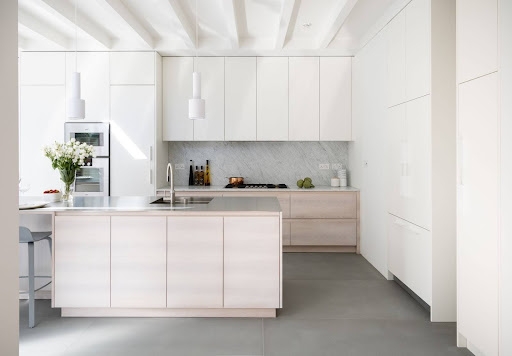
The best time to speak to a kitchen designer is before your plans, layouts and budgets are fixed, because that’s when your project has the greatest potential to evolve.
Most people delay speaking to a kitchen designer because they assume they’ll get better value once they have plans, a clearer budget or planning permission in place. It feels sensible to wait until the project is more defined.
The reality is almost the opposite. The earlier you involve the right design expertise, the more influence you have over the decisions that shape your home. By the time the project feels ready, many of those opportunities have already passed.
Knowing when to hire a kitchen designer is about involving the right expertise while there’s still the freedom to shape the project itself. When you’re planning a kitchen renovation, the most valuable conversations often happen before anyone has all the answers.
Most people think it’s too early
One of the first things we hear from new clients is, “We didn’t want to waste your time until we had some plans.” It’s an understandable instinct.
Most of us are conditioned to seek expert advice once we’ve defined the problem ourselves. We gather inspiration, sketch ideas, compare costs and try to understand what’s possible before involving anyone else.
Renovations don’t quite work that way. Unlike many other projects, the early decisions don’t simply come first – they influence everything that follows.
Waiting until the plans are complete can mean the conversation has already shifted from “What’s possible?” to “How do we make this work?” Those are very different discussions.
The earliest decisions have the biggest influence
People often associate interior design with colours, finishes and furniture. In reality, those decisions rest on a much deeper layer of thinking.
A study done by Houzz revealed that 31% of the homeowners that participated in their study renovated to rectify poor layout. It is a useful reminder that the quality of a renovation is shaped long before finishes are selected or construction begins.
Speaking to a kitchen designer before your architectural plans are finalised allows the conversation to begin with you about how you cook, where people gather, what needs to be stored and how you want the room to feel. Those insights can then inform the position of walls, doors, services, lighting and circulation rather than being squeezed into a plan that has already been decided.
Clients rarely come to us because they can’t choose a tap or a paint colour. They want someone to help them understand how all the individual decisions connect before those decisions become permanent.
During our work on the Denleigh Gardens project, for example, we joined the design team while the proposals were still evolving. Working alongside the architect, we were able to rethink the kitchen layout before construction began, improving storage, circulation and functionality while those changes were still straightforward to make.
Had those conversations happened later, many of those opportunities would already have disappeared.
Amberth’s Denleigh Gardens Project, where design informed construction from the beginning
Every decision narrows the next one
A renovation becomes more complicated because each decision reduces your remaining options.
Moving one wall influences the kitchen. The kitchen influences lighting. Lighting influences ceiling design. Ceiling design influences ventilation. Ventilation influences joinery.
By the time you’re choosing finishes, countless earlier decisions have already shaped what is and isn’t possible.
The earlier the right people are involved, the more freedom there is to explore different solutions.
The later they’re involved, the more energy is spent adapting to choices that have already been made.
Good planning creates more options, not fewer
Some homeowners worry that speaking to a kitchen designer early means committing to decisions before they’re ready. The opposite is usually true.
Early planning creates space to explore ideas without the pressure of construction deadlines or fixed layouts. It allows different options to be tested, challenged and refined before changing direction becomes expensive or disruptive.
This approach reflects a broader principle in good design. The Design Council’s Double Diamond framework begins by encouraging teams to understand the problem before jumping to solutions. Its first “Discover” phase is designed to help teams “understand, rather than simply assume, what the problem is” before moving on to define and develop solutions.
In renovation projects, the same principle applies. Spending more time asking the right questions early often leads to stronger decisions later, when the cost of change is much higher. Good planning protects flexibility.
Lighting was fully integrated into the design, having been considered from the architectural stage
The right time is probably earlier than you think
People often believe they need certainty before speaking to a designer. A complete brief. Finished drawings. A defined budget. A clear vision.
In reality, great projects begin with curiosity. With conversations about how you want your home to support your daily life. About what isn’t working today. About what your dream space would genuinely look like five or ten years from now.
“From the get-go, Amberth took me under their wings, so my experience was completely hassle-free. As this was my first home renovation, I didn’t know where to start, but the team used their expertise to pull all the pieces together. They guided me through the process, from drawing the designs to selecting the right products and providing a top-quality installation.” – Sylwia Kalinska
Read the full verified review and others on our Houzz profile
Great renovations begin with better questions
A successful renovation is the product of good timing. One thing we’ve noticed is that clients rarely regret involving the right people too early.
Much more often, they wish certain conversations had happened before layouts were fixed, services were coordinated, or construction had already begun.
People often think they need answers before they speak to a designer. In reality, the first conversation is about asking questions.
Every renovation has a moment when almost every option is still available. The challenge is recognising that moment before it has passed.
Thinking about your renovation?
If you’re still exploring ideas, now is often the right time to start the conversation. The earlier you involve the right people, the more opportunity there is to shape a home around the way you want to live, not simply adapt to decisions that have already been made.
Feel free to get in touch with us, or visit our studio in Islington to start a conversation, wherever you are in the process.
FAQs
When should I hire an kitchen designer?
Ideally, at the beginning of your renovation planning. Early involvement creates more opportunities to influence layouts, storage, lighting and the overall direction of the project before key decisions become fixed.
Is it too early to speak to a designer before I have plans?
Not at all. Some of the most valuable conversations happen before plans are drawn because they help shape the brief rather than simply responding to it.
Should I appoint an architect or an kitchen designer first?
Many successful renovations benefit from involving both disciplines early. Their expertise is complementary, and collaborative planning often leads to stronger, more cohesive outcomes.
Can early planning help avoid costly changes?
Yes. Resolving key design decisions before construction starts can reduce the likelihood of changes on site, where alterations are often more disruptive and expensive.
What if I don’t know exactly what I want yet?
That’s completely normal. A good design process starts by understanding how you live and what you want your home to achieve, not by expecting you to have every answer from day one.


