


If your newly renovated bathroom has been installed badly, it can leave you feeling frustrated and disheartened. The first step is not to start patching the visible problem. It’s to understand what has gone wrong underneath it, how far the problem extends, and what can genuinely be repaired without compromising the rest of the bathroom.
That can be difficult to hear when you thought your renovation was finished. You have already lived through the disruption, made hundreds of decisions and paid for the work. The tiles are up. The fittings are in. You should be enjoying your bathroom.
Then something does not look right. Perhaps water is collecting where it should drain away. Tiles are moving or cracking. A leak appears. Or you simply have the uncomfortable feeling that the finish is not what you were promised.
A poorly installed bathroom doesn’t automatically mean starting again. But before anyone tells you they can “just fix it”, you need to know whether you are looking at a finishing defect or a deeper installation problem.
First, Find Out What Has Actually Gone Wrong With Your Bathroom Renovation
One of the biggest mistakes we see with remedial bathroom work is treating the symptom before understanding the cause.
A cracked tile, for example, might simply be damaged. But cracking can also be caused by movement or problems with the surface beneath it. The visible defect is only the beginning of the investigation.
This is why we would be wary of anyone diagnosing a bathroom renovation problem from a photograph alone. The detail that matters most is often the detail you cannot see.

Before Any Repairs Begin, Do These Six Things
When you discover a problem in a newly renovated bathroom, it is tempting to get somebody in immediately and make the problem disappear.
Before remedial work begins, it is worth slowing down and doing this first:
- Record what you can see. Take clear photographs and note when the problem first appeared or what happens when the bathroom is used.
- Establish the likely cause. The person assessing it should be able to explain why they believe the problem has occurred, rather than simply pointing out the defect.
- Understand what needs to be opened up. Ask what has to be removed to investigate or correct the problem, and why.
- Ask what can be retained. A remedial specialist should be thinking about protecting sound work as well as replacing faulty work.
- Understand the whole repair. Removing a tile may affect waterproofing. Moving a fitting may affect plumbing. Reworking a floor may affect the shower screen or adjoining finishes. The plan needs to take those dependencies into account.
- Agree on the sequence before restarting work. You should understand what happens first, who is responsible for each stage, what materials need to be reordered and what the revised timeline looks like.
You should not have to enter a second bathroom renovation with the same uncertainty as the first.
If you are already at this stage and are unsure what should happen next, tell our team what has gone wrong with your bathroom. We can discuss the problem with you and establish whether Amberth is the right team to help.
Someone Had Already Renovated Our Client’s Bathroom Before They Called Us To Fix It
A homeowner near Sloane Square contacted Amberth after water from their previously renovated walk-in shower began leaking into the flat below. By that point, this was no longer simply an imperfection in a newly renovated bathroom. There was the worry about how much damage had been caused, what would need to be taken apart, and whether putting it right would mean paying to replace finishes they had already invested in.
We had not designed or installed the original bathroom, and from the surface it was impossible to tell how far the problem extended. The shower had a marble stone base, but once we carefully stripped back the affected area, we discovered that water was getting past the waterproofing and into the timber floor build-up beneath it. Parts of the floor had rotted over time, and there was no properly sloped, fully tanked base beneath the marble to carry water towards the waste.
Once the damaged area had been opened up, we rebuilt the shower base and applied a new waterproofing system across the base and its junctions before the replacement finish was installed. The work behind the marble was just as important as the finish that would eventually cover it – this was the part that needed to be put right if the homeowner was going to have confidence in using the shower again. The failure was hidden beneath a finish that, from above, could still look beautiful.
For the homeowner, this is precisely what makes this kind of bathroom problem so unsettling. You can see the leak, but you cannot know how much needs to come out, what can be saved, or what it will cost to put right until somebody establishes what has actually failed.
That did not mean everything had to be discarded. The existing glass shower door was still sound, so we carefully removed and retained it rather than replacing it unnecessarily. The remedial work was completed within a few days, and once it was completed, the glass shower door was refitted using its existing hinges and handle.
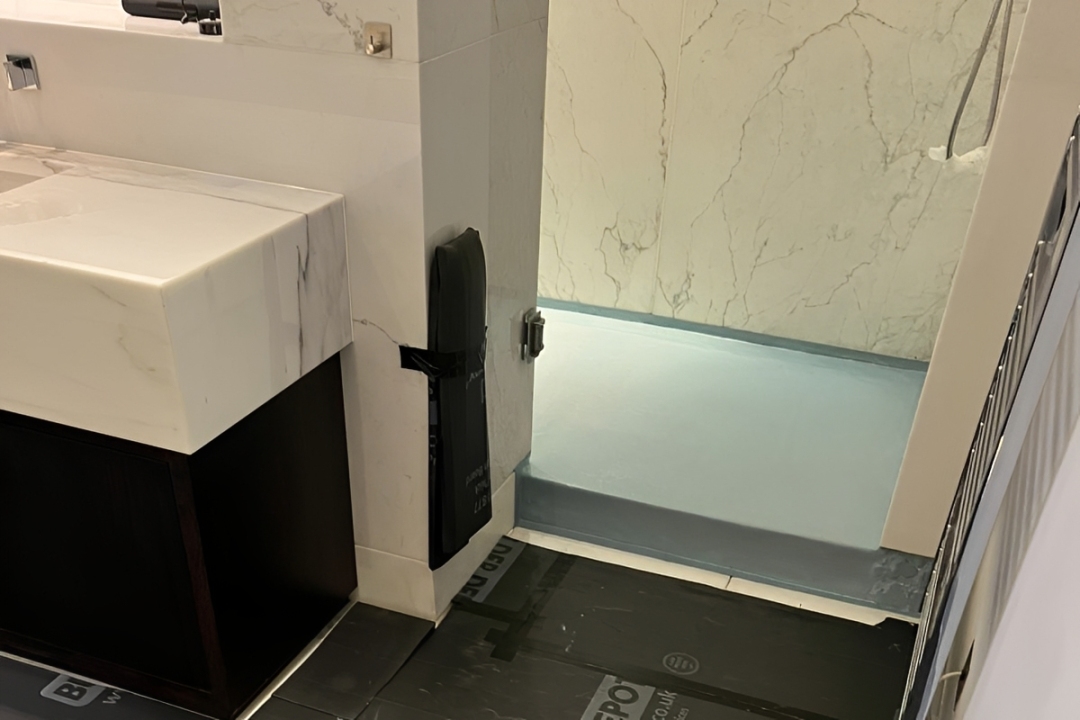 Rebuilding and waterproofing the walk-in shower near Sloane Square after the original installation allowed water to penetrate the floor beneath.
How Do I Know If The Cause Is Bad Installation?
Some signs that a bathroom may not have been installed correctly are easier to spot than others.
Things To Look Out For That May Indicate Poor Installation:
- Water collecting where it should drain away
- Persistent or unexplained leaks
- Tiles that move, crack or repeatedly come loose
- Grout or sealant that repeatedly fails
- Fittings that move or do not sit securely
- Finishes that appear uneven or noticeably different from what was specified
These signs do not prove poor installation on their own. A cracked tile, for example, could be locally damaged rather than evidence of a wider problem. But if an issue keeps returning, appears in several places or is accompanied by water damage or movement, it is worth investigating what is happening beneath the finished surface rather than repeatedly repairing what you can see.
The importance of resolving underlying conditions can be seen in our Southgate Road bathroom renovation, where the Victorian property had uneven floor levels and other structural issues. Rather than laying finishes over those conditions, we worked with the structural engineer and contractor to resolve them first as part of the renovation.
If this experience has made you question what should have happened before the finishes went in, we explain what actually goes into a high-end bathroom renovation, including the planning and technical decisions that happen behind the finished room.
“Problem solving: 10/10. The team dealt with all problems that arose efficiently. Main examples: structural steel beam too thick (ordered based on the structural engineer’s instruction….) which the team positioned in a manner to hide as far as possible, and bathroom wall not flat which the team added flattening layer (or whatever they have done) for tiling/shower panel.”
– Mandy Ching, Houzz
When Your Bathroom Renovation Has Gone Wrong, Who Should You Hold Responsible?
Once the cause has been established, it is understandable to want the problem put right as quickly as possible. But before another contractor begins remedial work, there are a few important steps to take.
The original installer would normally have the first opportunity to put their own work right
In most cases they should be given that opportunity in writing before anyone else starts work. Bringing in a third party too soon could affect a guarantee, warranty or potential claim, so establishing and documenting the cause is important for more than the quality of the repair.
Keep your original contract, specification, payment records and dated photographs together.
If there is any uncertainty about what failed or how extensive the problem is, an independent written assessment can provide a clear record of the cause and extent of the issue. Where the situation has developed into a dispute, advice should come from a solicitor or the relevant trade body rather than the contractor carrying out the remedial work.
Once you are in a position to proceed, the next challenge is coordinating the repair.
A bathroom problem rarely exists in isolation: correcting waterproofing may affect tiling, moving sanitaryware may involve plumbing, and opening up one area can reveal work that needs resolving before the finishes can go back.
After a renovation that has already gone wrong, the last thing you need is another fragmented process where you are left coordinating different trades and trying to work out who is responsible for what. This is why we place so much importance on coordinating design, supply and installation as one process. You can see how that approach comes together across our completed bathroom projects.
If your experience has left you questioning who should actually be responsible for coordinating the work, our guide to who should manage your bathroom renovation explains what good project ownership should look like.
A Bathroom Problem Does Not Always Mean Starting Again
When a bathroom you have already invested in goes wrong, it is easy to fear the worst: that everything will need to come out, the disruption will begin again, and you will end up paying twice for the same room.
That is why the most important first step is not rushing into another repair. Document what has happened, establish the underlying cause, and understand how far the problem extends. Before another contractor begins work, check where you stand with the original installer, any guarantees or warranties, and keep a clear record of the work that was originally agreed and completed.
You do not need to have all the technical answers yourself – what matters is having the right support to understand what has gone wrong and guide you through putting it right with confidence.
FAQs
Does a badly installed bathroom need to be completely redone?
Not necessarily. The extent of remedial work depends on where the failure sits and what needs to be done to correct it.
Can you fix bathroom waterproofing without removing the tiles?
If the waterproofing system behind the tiles has failed, simply resealing joints or regrouting the surface may not address the underlying problem. Access to the failed area can require finishes to be removed, although the extent depends on the location and cause of the failure.
Why do my bathroom tiles or grout keep cracking?
Cracking can be caused by something as simple as local damage, but recurring cracks can also indicate movement or problems with the sub surface supporting the tiles. Repairing the crack without understanding why it appeared can mean the same problem returns.
What should I do first if I think my bathroom renovation has gone wrong?
Document what you are seeing and avoid repeatedly covering up the symptom before the cause is understood. If there is an active leak, preventing further water damage is the immediate priority.
After that, get someone who knows what they are looking at to assess it properly: where the problem started, how far it has spread, and how much has to come out to put it right. A good assessment should also tell you why it failed, so the repair lasts.


