

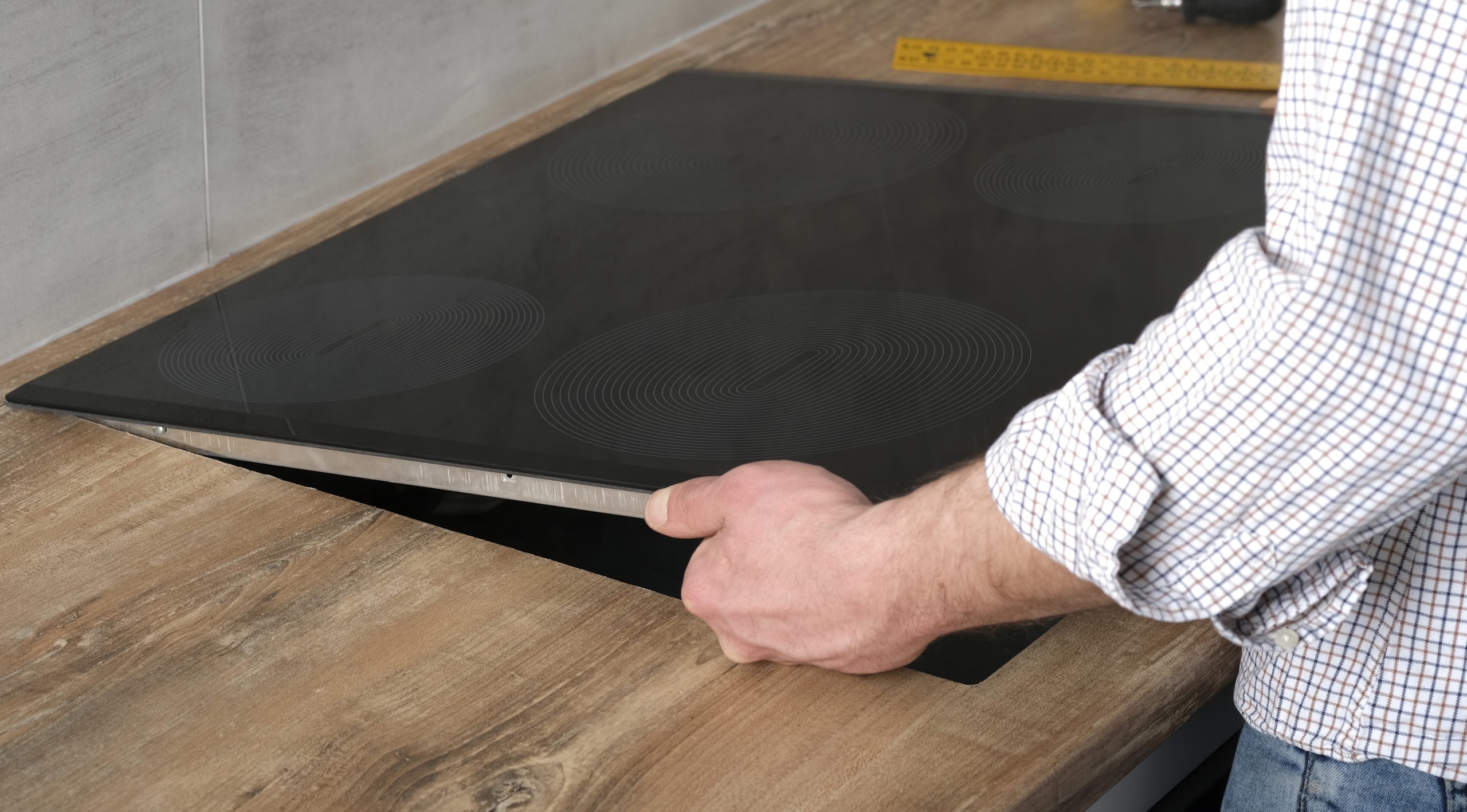
The best vented hob is not simply the one with the strongest specification. It is the one that works best with your kitchen and the way you use it. Your hob needs to work with far more than the worktop. At Amberth, appliance decisions are developed alongside your layout, cabinetry, storage and installation, so the kitchen works as one complete space.
This approach can give you clearer sightlines, more freedom around an island and a kitchen that feels more connected to the room around it. Our role is to balance that visual freedom with how you cook, the storage you need and the practical requirements of your home.
The extractor has to go somewhere. So do the filters, ducting and services. Depending on the model, your choice can affect the drawers beneath the hob, the cabinetry around it and even the way the island itself needs to be designed.
What Is a Vented Hob?
A vented hob combines the cooking surface and extraction in one appliance. Instead of drawing steam and cooking vapours upwards into a hood, it extracts them at worktop level. That makes vented hobs particularly useful on kitchen islands, where a suspended extractor can interrupt the view across an open-plan room.
Most premium systems can be designed for either:
- external extraction, where air is ducted outside; or
- recirculation, where grease and odours are filtered before the air is returned to the room.
Choose the Hob Before You Finalise the Kitchen
During the design phase with Amberth, you would be asked about how you cook on a lifestyle level. Which pans you use, what you need to store around the hob, and what makes cooking feel like a pleasure. After this, appliance specifics are checked against your kitchen’s requirements, including dimensions, cabinetry requirements and ventilation routes before the design is finalised.
Having that conversation with Amberth early means the hob, extraction and bespoke cabinetry can be planned together, rather than leaving you to solve a clash during installation.
Which Vented Hob Is Best for Your Kitchen?
There is no single best vented hob for every premium kitchen.
When Amberth manages a client’s kitchen renovation, it starts with what matters most to you: everyday cooking, entertaining, storage or a clear view across the room. Those priorities help narrow the options before comparing individual models.
Which vented hob suits your priorities?
Your choice affects more than the cooking surface. The width of the appliance, the sound of the extractor and the space it needs beneath the worktop all influence how your kitchen will work.
For a highly tailored cooking area: BORA
BORA, especially their Professional 3.0 model, allows you to combine different cooking surfaces around a shared extraction system.
- Width: Configurable. As an example, the two-cooktop PKAS3FIR induction set measures approximately 85cm wide.
- Noise: The PKAS3 integrated-fan extractor is rated at 47-67 dB during normal operation, rising to 71 dB on its power setting.
- Storage impact: The example set has an overall appliance height of approximately 20cm. Allow space for the extraction system, ducting and any recirculation filters. The drawer arrangement beneath it needs to be designed around these components.
For architectural flexibility: Gaggenau 400 Series
Gaggenau offers integrated vented hobs alongside separate modular extraction options, giving you flexibility in how the cooking area is arranged.
- Width: Integrated models are available in nominal 80cm and 90cm widths. Modular arrangements depend on the combination selected.
- Noise: The 90cm CV492105 is rated at 61-70 dB during normal extraction.
- Storage impact: The CV492105 requires an installation depth of approximately 23cm beneath the worktop surface, plus provision for ventilation. Expect the upper drawer area to be affected, with additional space potentially needed behind the cabinetry.
For a discreet integrated arrangement: Miele KMDA
Miele combines induction cooking and extraction in one appliance, with several installation options.
- Width: The KMDA 7876-1 FL MattFinish measures 80cm wide.
- Noise: This model is rated at 41-64 dB with external extraction and 46-68 dB with recirculation during normal operation. Booster levels reach 68 dB and 70 dB respectively.
- Storage impact: Its overall appliance height is approximately 24cm. Allow for this beneath the hob, together with the ventilation route. The upper drawer may need to be omitted or adapted, while storage below depends on the cabinet design.
For smart cooking technology: Siemens iQ700 inductionAir
Siemens offers flexible induction zones, sensor functions and connected features within an integrated arrangement.
- Width: The EX875LX67E is a nominal 80cm model, measuring approximately 81cm across its frame.
- Noise: This model is rated at 69 dB at its maximum normal extraction speed.
- Storage impact: Its overall appliance height is approximately 22cm. Storage beneath the hob needs to accommodate the appliance and ventilation components, which may mean an adapted upper drawer or reduced drawer depth.
For an open island with clear sightlines
Any of these systems may suit an open island when the appliance and installation are planned together.
At Amberth, we consider what you want to store beneath the hob before finalising the cabinetry. You can then see which drawers remain usable, how deep they can be and where pans, utensils and everyday essentials will go.
Noise deserves the same attention, particularly if your kitchen shares a room with dining or living areas. The figures above are manufacturer sound-power ratings at stated settings. Everyday sound will depend on the extraction speed, ventilation method and installation.
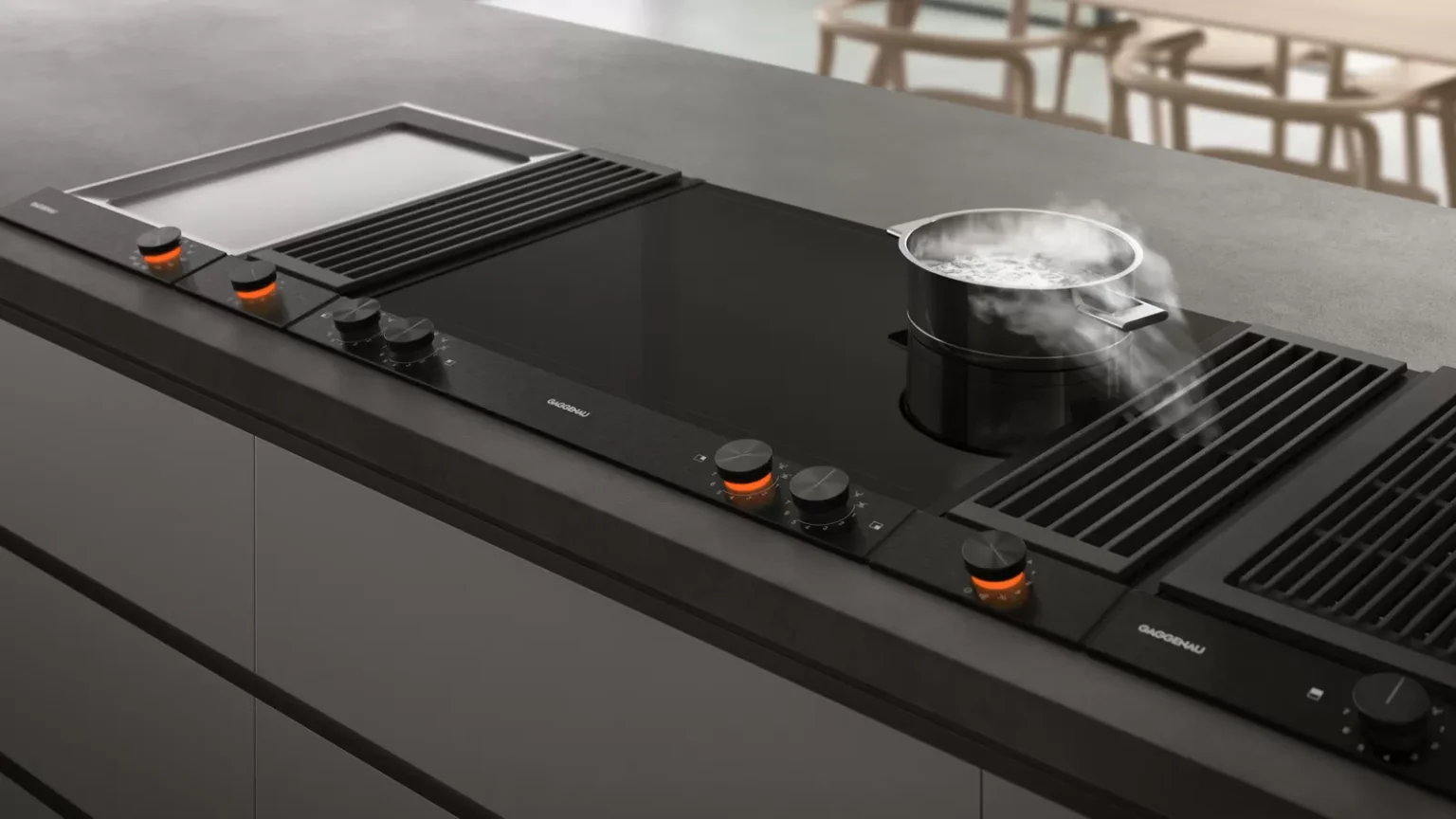 Gaggenau: Well suited to highly considered kitchens where the cooking area itself is part of the architecture and performance matters as much as appearance.
Gaggenau: When the Cooking Area Is Part of the Architecture
Gaggenau’s 400 Series vented hobs are worth considering when the cooking area itself is a significant part of the design. Gaggenau also offers separate Vario downdraft extraction that can sit alongside induction, gas, grill or Teppan Yaki model. It can sit alongside induction, gas, grill or Teppan Yaki modules.
If you told us you enjoy cooking on gas as well as induction, or regularly use a griddle, Gaggenau’s modular options could suit your routine. They allow us to plan different cooking surfaces together, rather than asking you to work around one standard hob.
If you mainly cook with a few familiar pans, a simpler integrated arrangement may serve you better. The value is in choosing the capabilities you will actually use.
Best Suited For:
Keen cooks who want different cooking surfaces and a kitchen designed around preparing food and entertaining.
If your layout has room for the cooking station as well as useful preparation space and storage, Gaggenau is an option you could consider. An integrated model may be more appropriate if you want a simpler arrangement.
As part of the kitchen design, we would coordinate the appliance dimensions, controls, cabinetry and ventilation so the cooking area works as a whole.
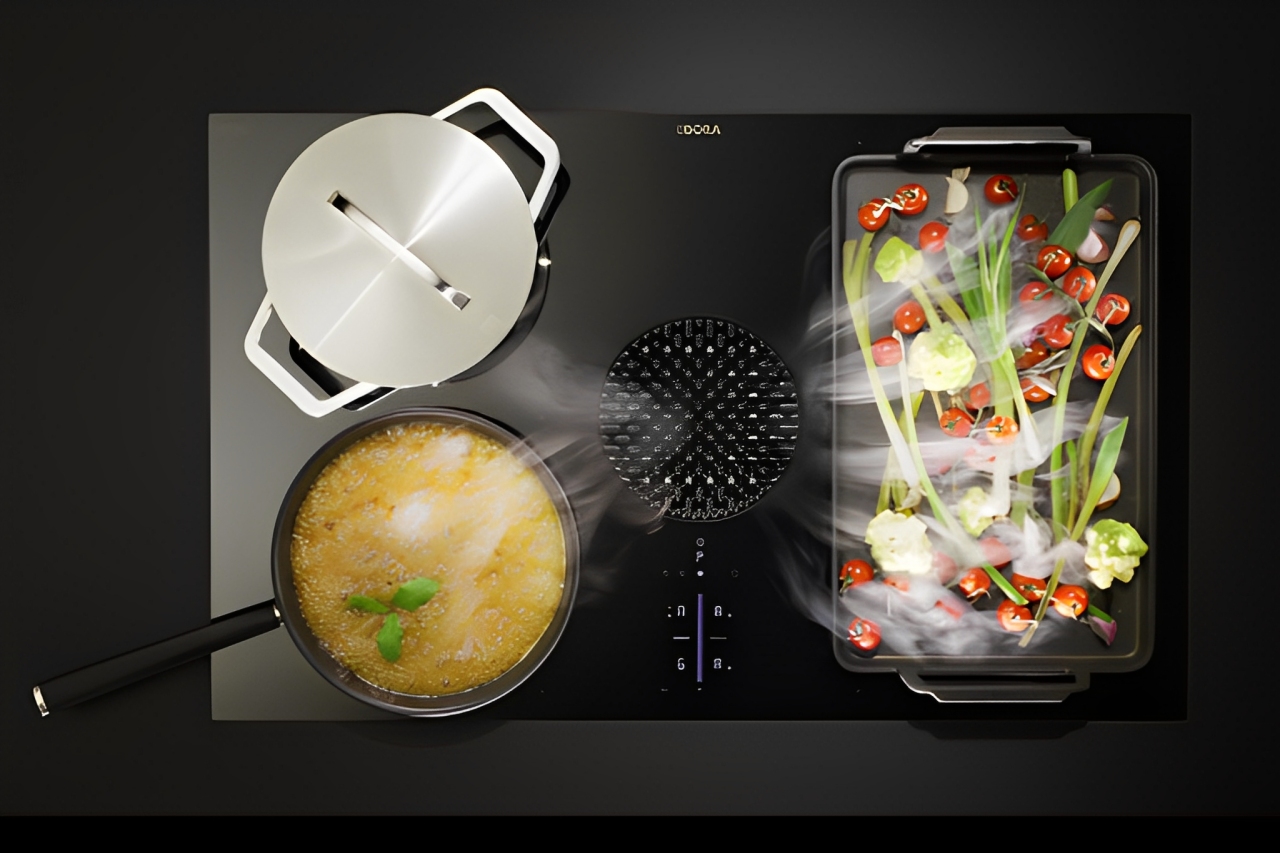 BORA: Ideal for clean, contemporary kitchens where hob and extraction need to work as one integrated system, with modular options for more tailored cooking.
BORA: When Hob and Extraction Need to Work as One System
BORA cooktop extractor systems put extraction at the centre of the appliance rather than treating it as an add-on. The range gives you two quite different propositions. The BORA X Pure is a clean, integrated option for a contemporary island.
The BORA Professional 3.0 is more configurable, allowing different cooktops to be combined around the extraction system. It is available for both exhaust-air and recirculation installations.
Best Suited For:
If you mainly want four flexible induction zones and discreet extraction, X Pure keeps things simple. If you want to combine induction with gas, wok or Teppan cooking, Professional 3.0 gives you much more control over the setup.
The important thing is not to confuse more choice with a better kitchen. If you will never use the extra capability, it is simply more appliance than you need.
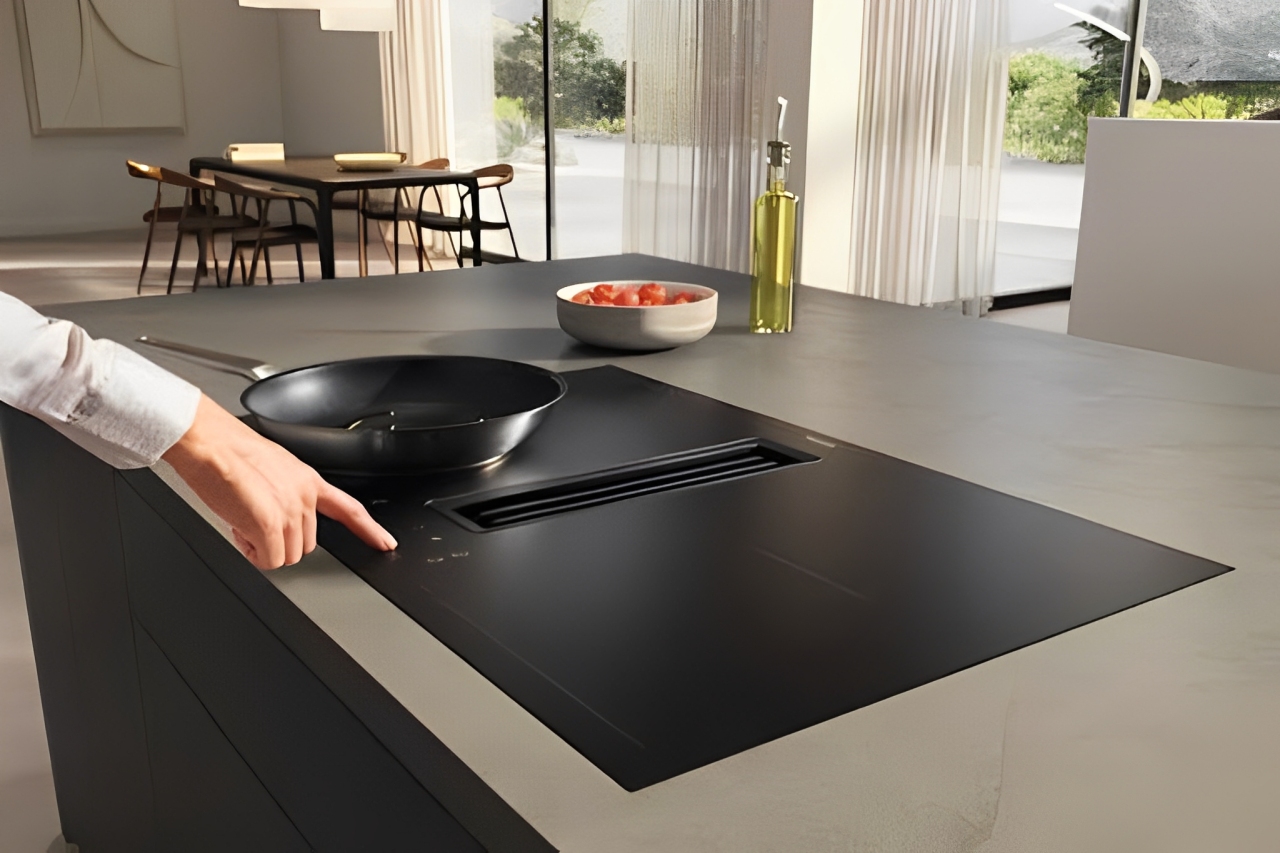 Miele: A good choice for a quiet, understated integration and reliable everyday performance in open-plan kitchens.
Miele: When You Want the Appliance to Sit Quietly in the Kitchen
Miele’s current integrated extraction hobs take a more contained approach. The current UK range includes several different models. Most combine induction and extraction in a hob around 80cm wide. For you, that means cooking and extraction can share one worktop area while keeping the space above it clear.
We would check the specific model’s installation requirements against your cabinetry and the ventilation route available in your home. Miele also places particular emphasis on quieter operation through its current SilenceMotor models.
Best Suited For:
If you want the hob to integrate neatly into the wider kitchen rather than make the cooking station a feature in its own right. That can matter in an open-plan room.
If someone is cooking while somebody else is eating, working or talking nearby, the experience of the appliance matters just as much as what it looks like switched off.
But we would still begin with something simpler than the specification sheet:
How many pans do you actually use at once?
What size are they?
Do you often cook for a crowd?
Which drawers do you want directly beneath or beside the hob?
Those answers usually tell us more.
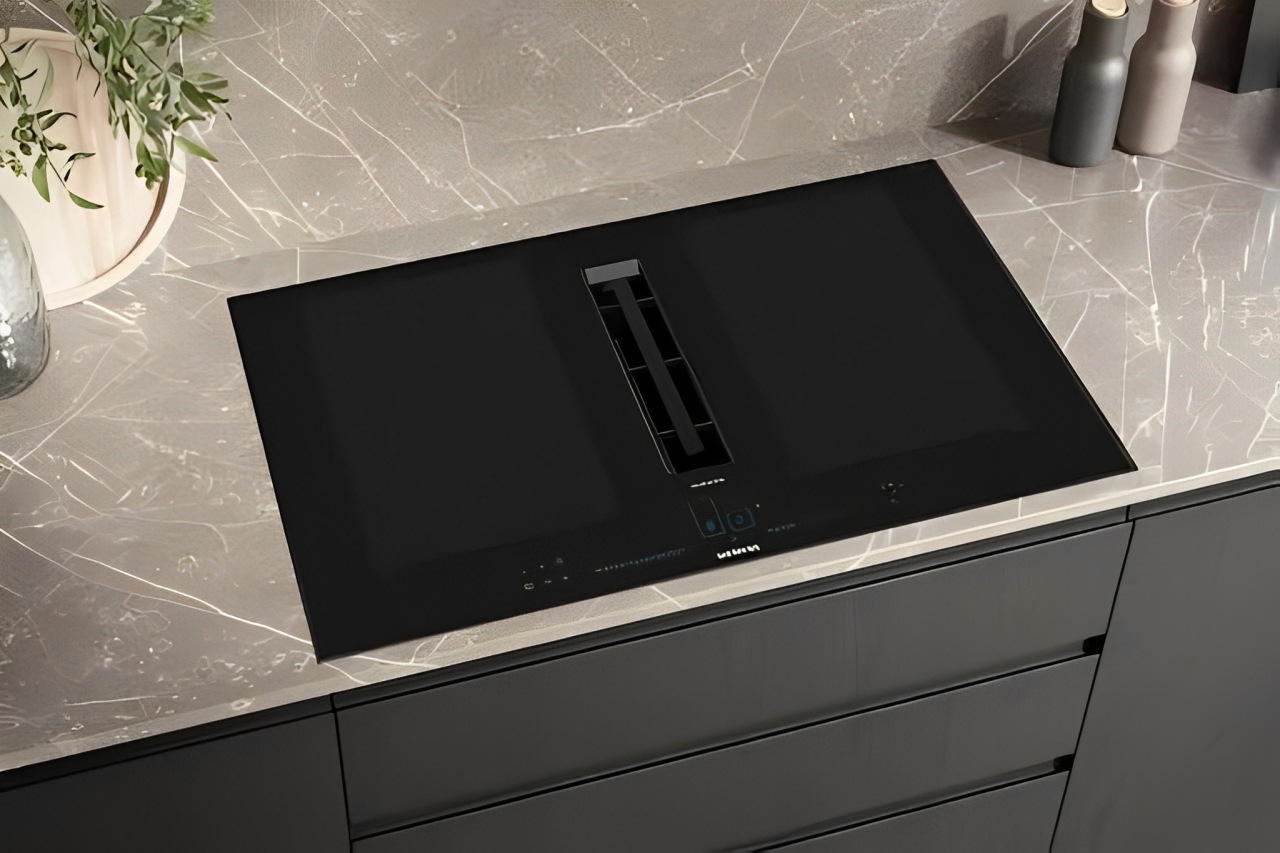 Siemens: For those who enjoy smart cooking features and flexible integrated extraction without moving into a more complex modular setup.
Siemens iQ700: When Smart Cooking Features Matter
Siemens offers integrated venting hobs across several widths and price points. Its iQ700 range includes 80cm options with integrated extraction, flexible induction zones and connected features.
Best Suited For:
The Siemens inductionAir system is worth considering when you want strong cooking technology without moving into a more elaborate modular setup.
It also makes sense when Siemens appliances are already being used elsewhere, and you want the kitchen to feel consistent.
We specified a Siemens Studioline vented hob in our Dvorak open-plan kitchen. The kitchen was designed as an open space for everyday life and entertaining. Keeping the extraction within the hob meant we could preserve the clean view across the island while the appliance sat subtly within the wider design. It is not simply a cleaner-looking island, but a kitchen where cooking can remain part of the conversation happening around it. That is what you want from an appliance decision. A better room.
Choose the hob. Let us fit the kitchen around it. Appliance, cabinetry and extraction, resolved before anything is ordered. Chat to our team.
What to Consider Before Choosing a Vented Hob
The part you buy is visible, but some of the most important implications are not.
You May Lose Some Storage
Extraction components, filters and ducting need space. Exactly how much depends on the appliance and installation. In a large kitchen, that may make very little difference.
In a London kitchen where every drawer is earning its place, it matters. That is why it is important to decide what the island needs to store before assuming the space below the hob is available.
The Air Still Needs Somewhere to Go
With external extraction, you need a sensible route to outside. With recirculation, the filtration and return airflow still need to be accommodated correctly. Neither option is a shortcut. They are simply different solutions.
You Need to Be Able to Maintain It
Grease filters need cleaning. Recirculation filters need maintenance or replacement. Components may eventually need servicing.
For example, Gaggenau’s current integrated 400 Series uses a removable dishwasher-safe grease filter and supports both extraction and recirculation.
Access should therefore be designed in from the beginning. A beautiful island is less successful if routine maintenance becomes an exercise in dismantling it.
Is a Vented Hob Always Better Than an Overhead Extractor?
Not always. Part of Amberth’s kitchen design service is helping you decide which type of extraction suits your room, rather than starting with a particular appliance.
During the design process, our team would consider sightlines, cooking habits, storage and the ventilation routes the building allows. A vented hob can be an excellent solution on an island when those requirements work together.
If an overhead extractor better supports the layout and the way you cook, this consideration would be planned into the kitchen instead. Our projects show how both approaches can work.
At our Lincoln Road family kitchen, we chose a ceiling-mounted hood above the island instead.
The island was designed as the centre of family life, with the sink and hob positioned so whoever was cooking could still face the dining area. The ceiling extractor kept the room open while working with that particular layout.
Dvorak and Lincoln Road are both open-plan kitchens. One uses a vented hob. One does not.
Both decisions work because they belong to the kitchen around them.
Ducted or Recirculating: Which Is Better?
Neither is automatically better for every property. External extraction takes the cooking air outside. Recirculation filters it before returning it to the room.
To help our clients make this decision, we look at:
- where the hob sits;
- whether there is a viable route outside;
- how long or complicated that route would be;
- the cabinetry around the appliance;
- maintenance requirements; and
- the manufacturer’s installation guidance.
This becomes particularly important when a kitchen is being moved. A hob that looks perfectly positioned on a plan still needs power and ventilation to reach it.
Our guide to relocating a kitchen successfully explains why those services need to be resolved with the layout rather than after it.
How Amberth Helps You Choose the Right Hob
Choosing a hob is one part of designing a kitchen that works for you. At Amberth, we bring that decision into the wider kitchen renovation, alongside the layout, bespoke cabinetry, storage and installation planning.
How do you cook? How often do you entertain? What do you want within easy reach? And what would you change about the way your current kitchen works?
Your answers help us narrow the options to appliances that make sense for you and your kitchen.
From there, we look at the wider picture. Your preferred hob needs to work with the layout, cabinetry, storage and extraction, without creating compromises elsewhere in the design.
If there is a trade-off, you will understand it before you commit. If an alternative would work better, we will explain why. You can then choose your hob knowing it has been considered as part of your kitchen, not in isolation.
That means the appliance, cabinetry, extraction and installation are resolved together before orders are placed, giving you greater certainty that the finished kitchen will work as intended.
Frequently Asked Questions
Are Vented Hobs Effective?
Yes, when the appliance and installation are right for the kitchen.
Vented hobs extract cooking vapour close to its source, but real-world performance depends on the product, installation, ventilation method and use.
Do Vented Hobs Take Up Cupboard Space?
Usually, to some extent. The motor, filters or ducting need to be accommodated beneath or around the hob. How much storage you lose varies by system.
Can You Put a Vented Hob on an Island?
Yes. An island is one of the places where a vented hob can make the most sense because it can remove the need for a hood directly above the cooking surface. The power supply, worktop, cabinetry and extraction route still need to be designed around it.
Is Ducted Extraction Better Than Recirculation?
Not in every kitchen. The right choice depends on the building, hob position and practical route available for ducting. Both can work well when correctly specified and installed.
Are Vented Hobs Difficult to Clean?
Premium systems are generally designed with regular maintenance in mind.
Many use removable grease filters that can be washed in a dishwasher, while recirculating models also require their odour filters to be maintained or replaced according to the manufacturer’s instructions.


